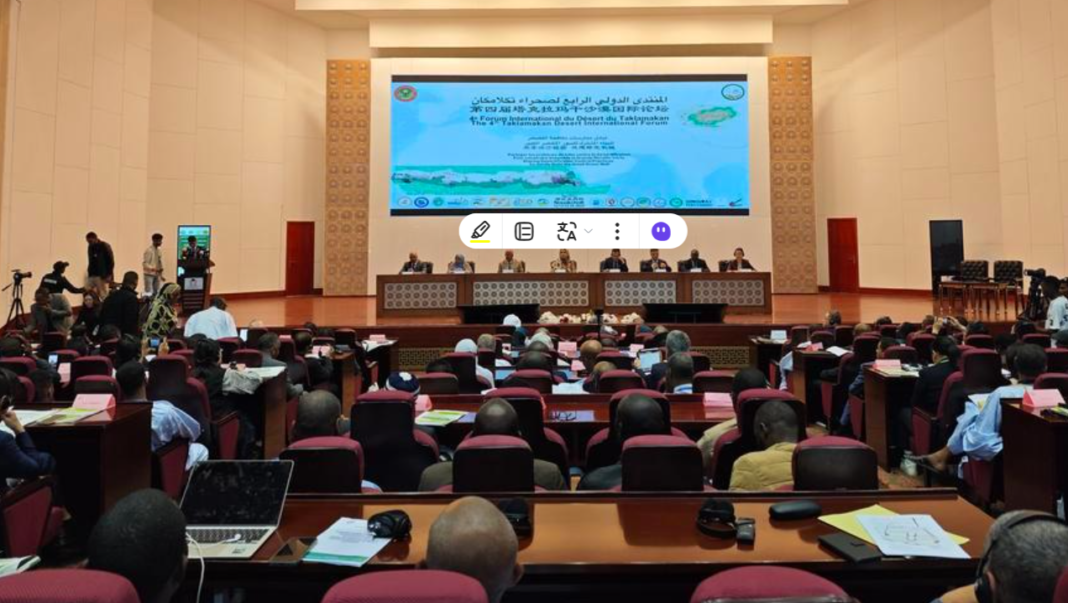

Officials and experts from China and Africa have called for stronger scientific and technological cooperation to tackle desertification and land degradation, stressing the need for closer coordination to advance Africa’s Great Green Wall initiative.
The call was made at the fourth Taklamakan Desert International Forum, held in Nouakchott, Mauritania, where participants underscored that desertification remains a shared global challenge that requires collective action, knowledge sharing, and long-term commitment.
Speaking at the forum, Duan Weili, Vice President of the Xinjiang Institute of Ecology and Geography under the Chinese Academy of Sciences, said China has developed a distinctive and effective approach to combating desertification through more than seven decades of sustained efforts.
According to Duan, China’s strategy combines scientific management, integrated treatment, and livelihood-oriented ecological restoration. He noted that China has taken a global lead in achieving “zero growth” of land degradation, adding that experiences from the management of the Taklamakan Desert, including the construction of ecological barriers and vegetation restoration along desert margins, could offer valuable lessons for Africa’s arid and semi-arid regions.
Duan said China is ready to deepen cooperation with African countries by strengthening research platforms, technology sharing, and capacity building to support the localization and practical application of desertification control technologies.
Also speaking, Sidna Ahmed Ely, Director General of Mauritania’s National Agency of the Great Green Wall, said the Sahara and Taklamakan deserts share similar ecological characteristics and governance challenges, making the forum a critical platform for dialogue between the two major desert ecosystems.
Ely noted that Mauritania has, in recent years, partnered with Chinese research institutions on pilot projects focused on dune fixation, vegetation restoration, and soil improvement. He expressed hope for expanded collaboration in areas such as information exchange, joint research, and environmental monitoring.
For his part, Xiao Wensheng, Economic and Commercial Counsellor at the Chinese Embassy in Mauritania, said combating desertification is an essential component of global governance. Since joining the United Nations Convention to Combat Desertification, China has explored solutions tailored to its national conditions and accumulated experiences that are both replicable and scalable, he said.
Xiao added that China is willing to strengthen policy coordination and scientific cooperation with African countries to support the Great Green Wall initiative and enhance regional ecological governance capacity.
Meanwhile, Mauritania’s Minister of Trade and Tourism, Zeinebou Mint Ahmednah, said climate change and land degradation have become critical challenges affecting food security and socio-economic stability across Africa. She described China–Mauritania cooperation in desertification control as a practical example of South-South cooperation.
Jointly organized by the Xinjiang Institute of Ecology and Geography, Mauritania’s Ministry of Environment and Sustainable Development, and the Alliance of National and International Science Organizations for the Belt and Road Regions, the forum featured keynote speeches, thematic discussions, and a roundtable dialogue between experts on the Taklamakan and Sahara deserts.
Participants agreed that sustained international collaboration will be essential to addressing desertification and ensuring long-term ecological and economic resilience across affected regions.