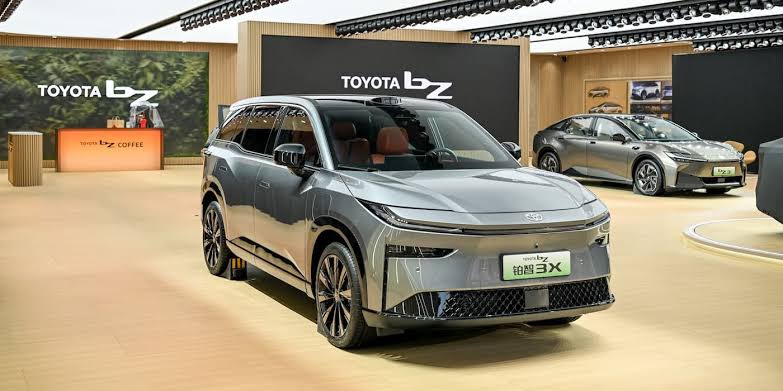

Toyota’s long-established strategy in China is facing a major reset as two of its biggest Chinese partners move closer to a restructuring that could reshape the Japanese automaker’s operations in the world’s largest auto market.
Guangzhou Automobile Group (GAC) and China’s FAW Group have signed a letter of intent for a major equity deal that could eventually bring Toyota’s two Chinese joint ventures closer together.
The development comes as China’s auto industry enters a period of intense consolidation, with traditional automakers facing slowing demand, excess production capacity and fierce competition from fast-growing Chinese electric vehicle brands.
Toyota’s Two-China Strategy Under Pressure
For decades, Toyota expanded across China through two major partnerships.
In the north, it operates FAW Toyota with FAW Group, while in the south it runs GAC Toyota with Guangzhou Automobile Group.
The strategy helped Toyota establish a strong presence across China as vehicle demand surged.
But the market has changed dramatically.
Chinese brands such as BYD, Geely and Chery have rapidly expanded their market share, particularly through electric and hybrid vehicles. At the same time, intense price competition has squeezed profits across the industry.
Toyota’s two Chinese joint ventures accounted for about 7% of passenger vehicle sales in the first eight months of 2026, according to industry data cited by Reuters.
That represents a sharp decline from their position several years ago, showing just how quickly the competitive landscape has changed.
GAC And FAW Make A Major Move
The latest development began when GAC announced plans to acquire part of FAW’s stake in an auto joint venture.
The companies have not officially disclosed the name of the venture, but Chinese state media and industry reports identified it as FAW Toyota.
If completed, FAW would become GAC’s second-largest shareholder, giving the two major Chinese state-backed automakers a much closer relationship.
The proposed transaction still requires further approvals and is not yet final.
However, its potential impact on Toyota has already attracted significant attention because both companies separately operate Toyota joint ventures in China.
Could Toyota’s Two Joint Ventures Be Combined?
The biggest question is whether the restructuring could lead to a closer integration of FAW Toyota and GAC Toyota.
Reports indicate that a unified sales structure is being considered, potentially bringing the two Toyota operations under a more coordinated system.
One reported proposal would see Toyota retain a 50% stake, while FAW and GAC would each hold 25% in a combined sales structure.
Such a move could allow Toyota to reduce duplicated operations, streamline distribution and make faster decisions in an increasingly competitive market.
Toyota has already taken steps to simplify parts of its Chinese operations. The company and FAW recently agreed to restructure the management of FAW Toyota’s manufacturing operations, with the aim of improving efficiency and speeding up decision-making.
China’s EV Boom Changes The Game
Behind Toyota’s restructuring is a much bigger transformation.
China has become the centre of the global electric vehicle industry, with domestic companies moving aggressively into electric cars, intelligent driving systems, batteries and vehicle software.
BYD, Geely and Chery have become increasingly powerful competitors, while Chinese automakers are also expanding beyond the domestic market.
This has placed traditional foreign manufacturers under enormous pressure.
Toyota remains one of the world’s largest automakers, but its traditional strength in China is being challenged by consumers who increasingly want vehicles packed with advanced technology, connected features and electrification.
Simply producing reliable petrol-powered vehicles is no longer enough to guarantee dominance.
A Wider Shake-Up Is Coming
Toyota’s situation could also be an early sign of a much broader restructuring across China’s automotive industry.
China has more than 100 competing vehicle brands, while years of rapid investment have created substantial excess manufacturing capacity.
The resulting price war has pushed profit margins lower and made it increasingly difficult for companies to maintain overlapping production and distribution networks.
Chinese authorities have been encouraging mergers and restructuring to address these problems.
The country’s latest industrial policy also calls for stronger consolidation in the intelligent connected and new-energy vehicle sector, including mergers and cross-regional integration among automakers.
Analysts now expect the restructuring trend to extend beyond Toyota.
Other global automakers, including Volkswagen and Honda, are also reassessing how they operate in China as local competitors become stronger and the market moves rapidly towards electric and intelligent vehicles.
What It Means For Toyota
For Toyota, closer integration could bring immediate benefits.
A more unified operation could reduce duplicated investments, lower costs and create a stronger distribution network.
But analysts warn that efficiency alone may not solve Toyota’s deeper challenge in China.
The bigger issue is technological relevance.
Chinese consumers are increasingly choosing vehicles based not only on traditional factors such as reliability and price, but also on batteries, software, connectivity, artificial intelligence and advanced driver-assistance technology.
That means Toyota will have to compete on technology as aggressively as it competes on manufacturing.
China’s Auto Industry Enters A New Era
The possible Toyota restructuring therefore represents more than a corporate adjustment.
It reflects a fundamental change in China’s automotive landscape.
The era when foreign automakers could dominate through large joint ventures and expanding dealership networks is giving way to a market driven by electric vehicles, software, technology and rapid product development.
For Toyota, the next phase in China may require fewer overlapping structures, faster decisions and much deeper adaptation to local consumer preferences.
And as GAC and FAW move closer together, the message from China’s rapidly changing auto market is becoming increasingly clear: the companies that cannot adapt quickly may struggle to survive the next phase of the electric vehicle revolution.