
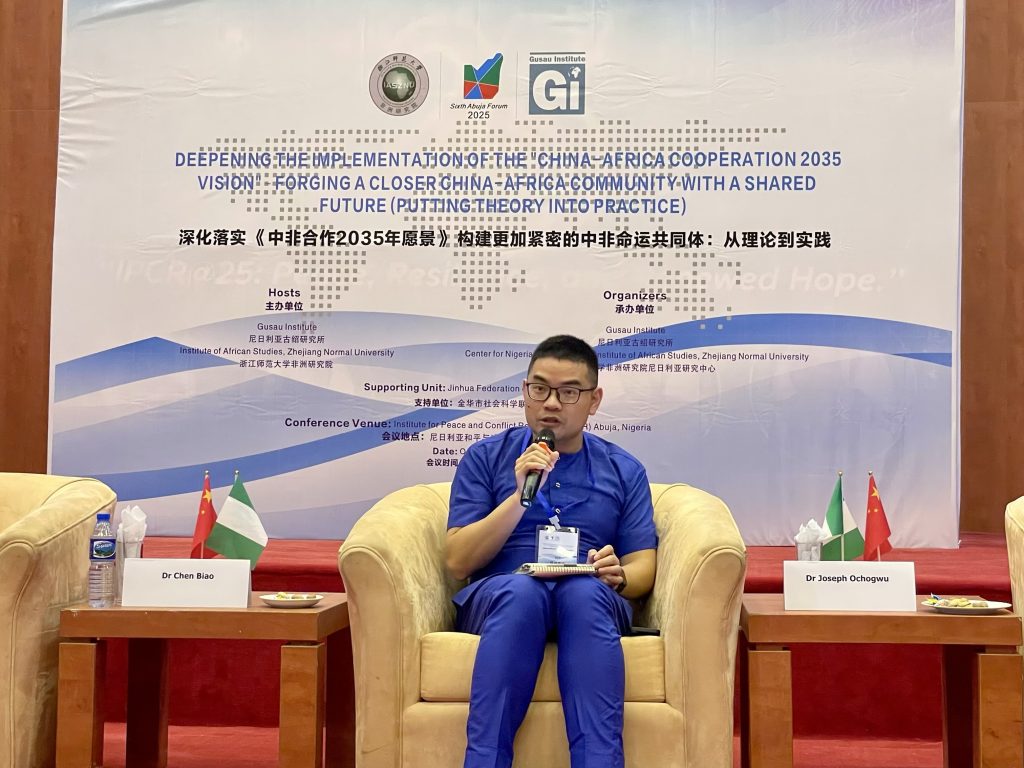
Abuja, Oct. 24, 2025- A lecturer, Dr Chen Biao, has called for a stronger China-Africa cooperation to promote localisation, technology transfer, and innovation in Africa’s renewable energy transition.
Chen, a research fellow at the Institute of African Studies at the Zhejiang Normal University (ZJNU) made the call in Abuja at the 2025 Abuja Forum on Deepening the Implementation of the China-Africa Cooperation 2035 Vision.
The vision he said aimed to forge a Closer China-Africa Community with a Shared Future.
Chen stated that Africa must strengthen local capacity and policy coordination to fully benefit from the continent’s clean energy potential.
He noted that China’s renewable energy capacity exceeded 1,500 gig watts in 2023, accounting for 52 per cent of total power generation, adding that the country’s experience offers valuable lessons for Africa’s green industrialisation.
Chen cited successful projects such as the Sakai Solar Plant in the Central African Republic and the De Aar Wind Farm in South Africa as examples of productive energy collaboration.
He urged African governments and Chinese investors to focus on joint research, local manufacturing, and innovative financing such as green bonds to drive sustainable energy development.
“Through energy cooperation, we must empower communities through skills, jobs, and shared growth,” he said.
Chen highlighted institutional frameworks guiding cooperation, including the Forum on China-Africa Cooperation (FOCAC), the Beijing Action Plan, and the China-Africa Union Energy Partnership, alongside the 2023 China-Africa Renewable Energy Cooperation Report.
He noted that ongoing collaborations between Chinese firms and African countries include power dispatch systems, grid upgrades, and micro-grid innovations led by China Southern Power Grid in Zambia, and Mozambique.
He also referred to a recent MOU between Nigeria and a Chinese multinational company for the establishment of a solar panel production facility.
Chen also recommended that both sides prioritise integrated policy planning, technology creation, local manufacturing, and innovative financing models, such as green bonds and capital, to enhance sustainability.
He urged investment in training African technicians and engineers, strengthening people-to-people bonds, and creating localised industrial chains to drive long-term green growth.
Speaking at the forum, Dr Suleyman Ndanusa, an economist, stressed the importance of sustainable and inclusive development, highlighting energy as the foundation of economic growth, security, and human welfare.
He commended China’s growing emphasis on renewable energy during the 14th Five-Year Plan period; Chinese power companies have invested over 272 million dollars in Africa’s renewable sector, securing engineering contracts worth 25 billion dollars.
Ndanusa stressed that the China-Africa partnership should continue to evolve into a mutually productive relationship, focusing on technology transfer, job creation, and local value addition, rather than dependency on imports.(NAN)