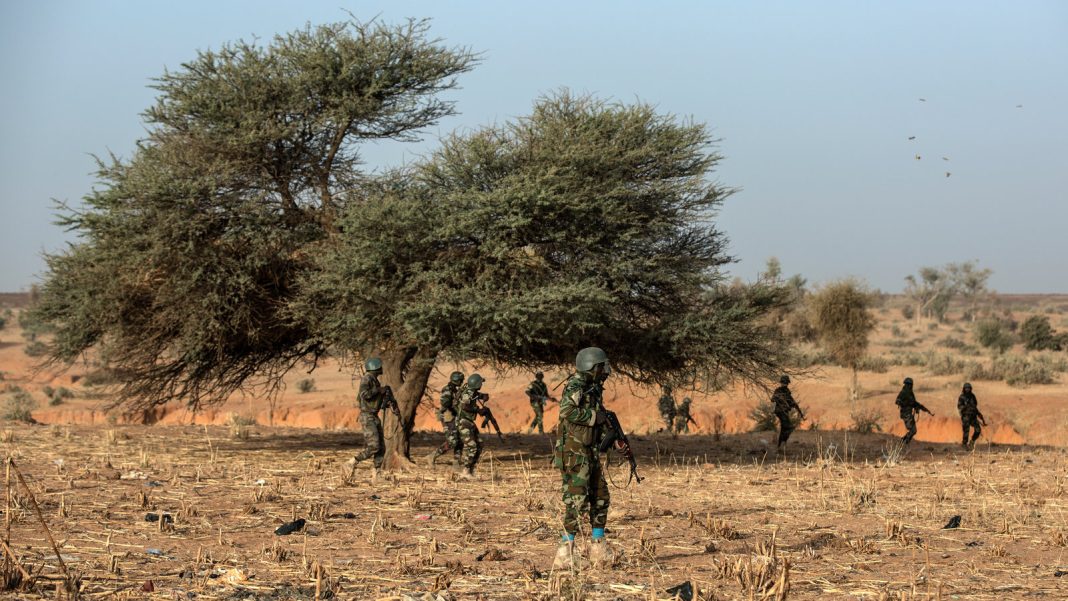
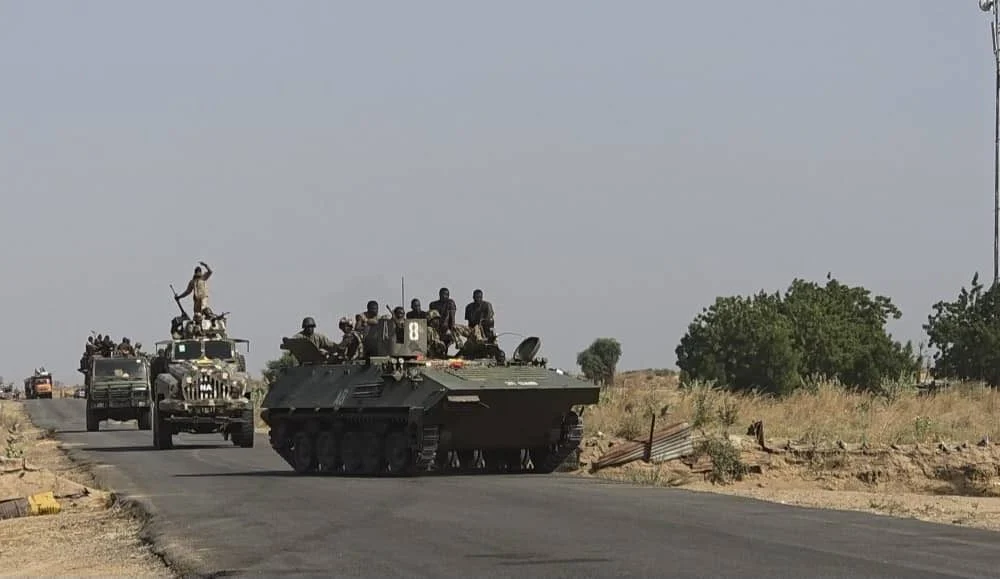

Nigerian troops operating in the North-East have intercepted a consignment of suspected terrorist logistics supplies in Yobe State, arresting two alleged suppliers and recovering large quantities of motorcycle spare parts, shoes and other items believed to be intended for insurgent activities.
The operation, conducted around Gumsa Bridge in Geidam Local Government Area of Yobe State, was reportedly based on human intelligence and forms part of ongoing efforts by the Nigerian military to disrupt the supply networks supporting terrorist groups in the region.
Among the items recovered were 50 motorcycle tyres, 80 piston kits and 146 chain-and-sprocket sets, alongside crankshafts, bearings, brake components, clutch parts, ignition and fuel-system components.
Troops also recovered 145 pairs of shoes and mobile phones during the operation.
The two suspects, who were reportedly arrested in connection with the shipment, and the recovered items have been handed over to the 27 Military Intelligence Regiment for further investigation.
While the seizure does not involve the kind of weaponry normally associated with counter-terrorism operations, its significance lies in what the recovered items could potentially provide to armed groups: mobility and the ability to sustain operations.
The logistics behind insurgency
In the difficult terrain of North-East Nigeria, motorcycles can provide armed groups with an important means of transportation, particularly in rural and hard-to-reach areas.
Maintaining that mobility, however, requires a steady supply of spare parts.
Tyres wear out. Chains break. Engines require pistons and crankshafts. Brake and clutch systems need replacement components.
For this reason, disrupting the supply of seemingly ordinary commercial products can become an important part of counter-terrorism operations.
The latest seizure demonstrates that the battle against insurgency extends beyond the battlefield. Security forces are increasingly seeking to identify and disrupt the networks responsible for acquiring, transporting and distributing the resources required to sustain terrorist activities.
This raises a broader question about the structure of insurgent logistics in the region.
Who purchases these supplies? Who finances them? Where are they sourced? How are they transported, and who ultimately receives them?
The answers could be more important than any single seizure.
From suppliers to supply chains
The arrest of two suspected logistics suppliers could provide investigators with an opportunity to trace the wider network connected to the intercepted consignment.
If investigators are able to establish where the goods originated, identify their intended recipients and determine how the transaction was financed, the operation could potentially disrupt a larger logistics chain rather than simply stopping one shipment.
That distinction is important.
An insurgent organisation requires more than weapons to remain operational. It needs transportation, fuel, food, communications equipment, clothing, funding and access to repair materials.
Cutting off any one of these resources may create operational difficulties. Repeatedly disrupting several components of the supply chain, however, could place sustained pressure on an armed group’s ability to operate.
Why the seizure matters beyond Yobe
The operation also highlights a wider challenge facing security agencies across Africa: the movement of legitimate commercial goods can sometimes intersect with illicit supply networks.
Motorcycle spare parts, shoes and other everyday commodities have legitimate uses and are widely traded across African markets. Their interception in this case does not, by itself, establish that such products are inherently linked to terrorism.
Rather, the military’s investigation will be important in determining the origin, ownership, financing and intended destination of the specific shipment.
This is where intelligence-led security operations become critical.
Instead of relying solely on armed confrontations, security agencies can target the financial, transportation and procurement networks that enable violent groups to maintain their operations.
A quieter front in the war
The seizure at Gumsa Bridge may not generate the same headlines as an air strike or a major battlefield confrontation, but it represents a quieter dimension of Nigeria’s counter-terrorism campaign.
The war against insurgency is fought not only where soldiers encounter armed fighters but also along the routes through which supplies move.
For every motorcycle used to transport an insurgent, there must be fuel and maintenance.
For every operation conducted in remote terrain, there must be a network capable of sustaining it.
And for every supply shipment intercepted, there is potentially an intelligence trail leading to those financing or facilitating it.
The recovery of 50 motorcycle tyres, 80 piston kits, 146 chain-and-sprocket sets and 145 pairs of shoes therefore tells a story that extends beyond the individual items.
It illustrates the importance of attacking the infrastructure that allows insurgent groups to remain mobile and operational.
As Nigerian security forces continue operations in the North-East, the ability to identify and dismantle these supply networks could prove just as important as confronting insurgents directly.
In the fight against terrorism, sometimes the most important target is not the person carrying the weapon, but the network that keeps that person supplied.