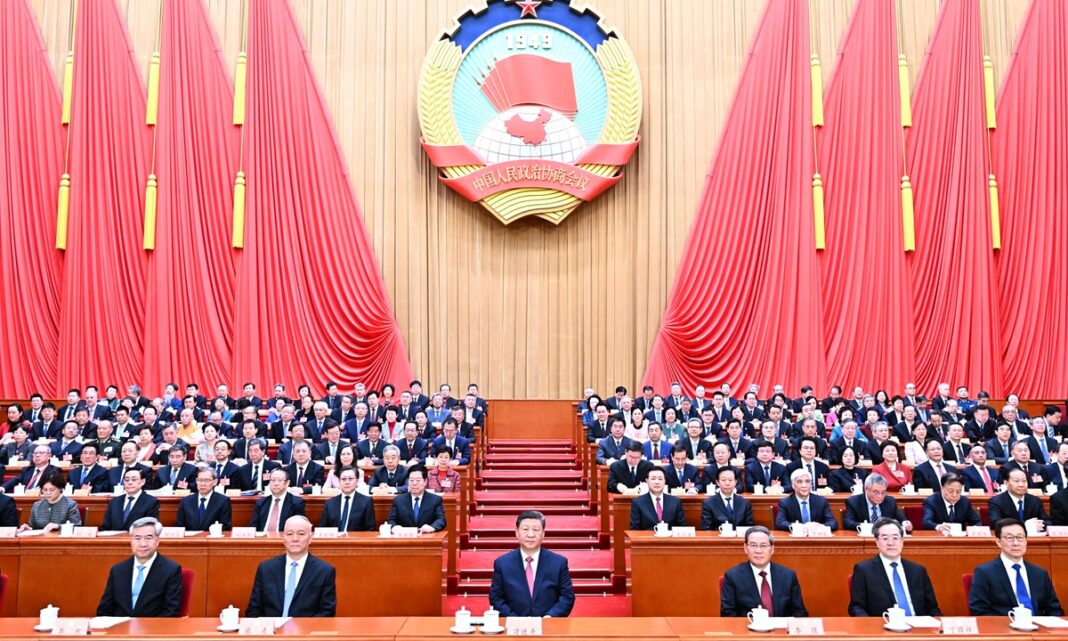

China’s top political advisory body, the National Committee of the Chinese People’s Political Consultative Conference (CPPCC), will hold its annual session from March 4 to 11 in Beijing, a spokesperson for the session said on Tuesday.
The fourth session of the 14th CPPCC National Committee will begin at 3 p.m. on Wednesday and conclude on the morning of March 11, spokesperson Liu Jieyi said at a news conference.
The National Committee of the Chinese People’s Political Consultative Conference (CPPCC) stands as one of China’s most distinctive political institutions. Often described as the country’s premier advisory body, it serves as a key platform for multiparty cooperation, political consultation, and the practice of whole-process people’s democracy under the leadership of the Communist Party of China (CPC). While it holds no legislative power, unlike the National People’s Congress (NPC), the CPPCC plays a vital role in gathering diverse voices from across society to advise on major policies, foster consensus, and contribute to national governance.
The CPPCC traces its roots to the revolutionary struggles of modern China. Its foundational moment came in September 1949, when the First Plenary Session convened in Beijing (then Beiping) just days before the founding of the People’s Republic of China (PRC). At that historic gathering, delegates from various political parties, organizations, and sectors acted as an interim legislature, adopting the Common Program (serving as a provisional constitution), selecting the national flag, anthem, capital, and leadership, and laying the groundwork for the new republic.
After the NPC was established in 1954 as China’s highest organ of state power, the CPPCC transitioned into its enduring role as a united front and consultative body. It weathered the Cultural Revolution but was revitalized in the late 1970s under Deng Xiaoping. Subsequent CPC leaderships, including those of Jiang Zemin, Hu Jintao, and especially Xi Jinping since 2012, have strengthened its institutional framework through key guidelines and conferences. In the new era, the CPPCC has been positioned as an essential component of China’s socialist consultative democracy and system of governance.
The CPPCC operates through a National Committee at the central level and local committees at provincial, prefectural, and county levels. The National Committee is elected for a five-year term. It consists of a Plenary Session (held annually, typically in March as part of the “Two Sessions” alongside the NPC), a Standing Committee for day-to-day affairs, and a Chairperson’s Council.
The National Committee currently comprises 2,169 members and a Standing Committee of 324. It maintains around 10 special committees focused on areas such as economics, population and resources, ethnic and religious affairs, foreign affairs, and culture. These bodies conduct surveys, inspections, and consultations that feed directly into policy recommendations.
Leadership of the 14th National Committee is headed by Wang Huning, a member of the CPC Politburo Standing Committee, who serves as Chairman. He is assisted by a team of vice-chairpersons (including figures such as Shi Taifeng, Hu Chunhua, and others representing diverse sectors) and a Secretary-General. All chairpersons of the National Committee since its founding have been senior CPC leaders, underscoring the body’s integration with the Party’s united front system.
One of the CPPCC’s most distinctive features is its sectoral composition, which ensures broad representation. The 14th National Committee draws members from 34 sectors, including: The CPC and the eight non-Communist democratic parties, prominent individuals without party affiliation, people’s organizations (e.g., trade unions, women’s federation, youth league), ethnic minorities and religious groups,
compatriots from Hong Kong, Macao, and Taiwan, as well as returned overseas Chinese. Professional sectors such as science and technology, economics, education, literature and arts, medicine and health, agriculture, sports, and more
Specially invited individuals.
Members are selected through consultation rather than direct election, reflecting the body’s emphasis on consensus-building. They come from all walks of life; experts, entrepreneurs, artists, athletes, and community leaders, bringing specialized knowledge and grassroots perspectives to national deliberations.
The CPPCC performs three primary functions, as outlined in its Charter:
-Political Consultation: Offering advice on major national policies, economic plans, and social issues before decisions are finalized.
-Democratic Oversight: Providing constructive criticism and monitoring the implementation of laws, policies, and government work.
-Participation in Deliberation and Administration of State Affairs: Submitting proposals (thousands annually), conducting research, and helping translate ideas into actionable policies.
In practice, CPPCC members submit proposals on topics ranging from economic development and environmental protection to education reform and technological innovation. These are reviewed by government departments, with high response and implementation rates. The body also organizes biweekly consultations, thematic seminars, and inspections to deepen its advisory impact.