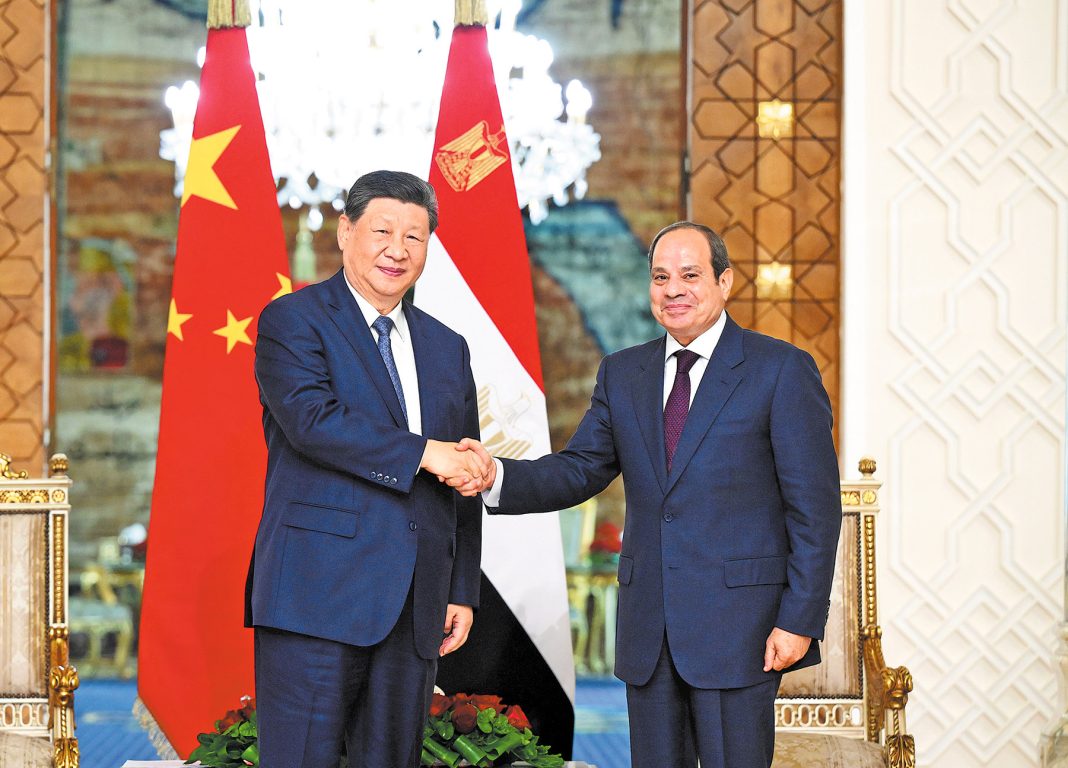

China and Egypt are strengthening their long-standing relationship, with both countries placing greater emphasis on trade, infrastructure, technology, security and cultural exchanges.
The relationship has gained renewed attention as China and Egypt mark 70 years of diplomatic relations.
Chinese President Xi Jinping recently visited Cairo for talks with Egyptian President Abdel Fattah El-Sisi. The visit highlighted the growing strategic importance of ties between the two countries.
Why Egypt is important to China
Egypt occupies a strategic position linking Africa, the Mediterranean and the Middle East.
For China, the country is an important partner in expanding westward trade. Its location also provides access to the Suez Canal, one of the world’s key trade routes.
Egypt is also viewed as a politically stable partner in a region facing persistent instability.
For Egypt, China has become an important economic partner as the country seeks to modernise and diversify its economy.
Cairo also sees China as a potential stabilising force in the region and has shown growing interest in China’s economic and technological capabilities.
Belt and Road Initiative drives cooperation
The Belt and Road Initiative (BRI) has been central to the expansion of China-Egypt economic cooperation since its launch in 2013.
The partnership covers infrastructure development, trade, technology and cultural exchanges.
Egypt’s 2030 Vision has also created opportunities for closer cooperation with China, particularly in the development of a modern and knowledge-based economy.
One major example is Egypt’s New Administrative Capital, where Chinese companies have played a significant role in construction and infrastructure development.
Suez Economic Zone attracts Chinese investment
The China-Egypt Suez Economic and Trade Cooperation Zone, known as TEDA, has emerged as a major industrial and logistics hub.
The zone is designed to attract businesses involved in manufacturing, logistics, technology and finance.
Its location near the Suez Canal gives Chinese companies a strategic base for accessing international markets.
The partnership is also moving beyond traditional infrastructure projects.
TEDA is increasingly focusing on smart logistics, automated warehouses and digital port management systems.
Chinese companies are also introducing technologies linked to industrial automation, renewable energy manufacturing and digital customs.
At the same time, financial links are expanding through RMB settlement channels, Chinese bank financing and Belt and Road investment mechanisms.
Chinese technology supports Egypt’s development
Chinese involvement in Egypt extends beyond industrial projects.
The New Administrative Capital has become a prominent example of Chinese engineering and construction capabilities.
The 385.8-metre Iconic Tower, described in the source as Africa’s tallest building, has become one of the most visible symbols of the country’s modernisation drive.
The growing presence of Chinese technology and businesses in Egypt could also provide a model for deeper economic engagement between China and other countries in the Global South.
China-Egypt security cooperation grows
Economic cooperation is not the only area where China and Egypt are strengthening ties.
Security and military cooperation between the two countries has also expanded.
Shortly before Xi’s visit, China and Egypt held the joint air exercise known as “Eagles of Civilization.”
The exercise involved Chinese J-16 fighter aircraft operating alongside Egyptian Dassault Rafale and MiG-29M2 jets.
The exercise demonstrated the growing level of military engagement between the two countries.
Cultural exchanges bring both countries closer
People-to-people exchanges are also becoming an increasingly visible part of China-Egypt relations.
The source notes that younger Egyptians’ exposure to Chinese culture has expanded beyond traditional associations with kung fu.
Today, some Egyptians practise tai chi and qi gong, visit Chinese restaurants, watch Chinese films and work alongside Chinese employees.
Mandarin is also being taught in some Egyptian high schools, creating another channel for cultural exchange between the two countries.
A relationship shaped by history
China and Egypt established diplomatic relations 70 years ago at a time of major political tensions in the Middle East.
The 1956 Suez Crisis followed Egypt’s nationalisation of the Suez Canal and the subsequent military intervention by Israel, Britain and France.
The crisis eventually ended with the withdrawal of the invading forces following international pressure.
Today, China and Egypt continue to emphasise the importance of peace and stability in the region.
China-Egypt partnership gains global significance
China is the world’s second-largest economy and a major global military power, while Egypt is the most populous Arab country.
Their combined strategic importance gives the bilateral relationship significance beyond their respective borders.
As economic, technological, security and cultural cooperation continues to expand, China-Egypt relations are becoming an increasingly important part of the wider relationship between China, Africa and the Global South.