

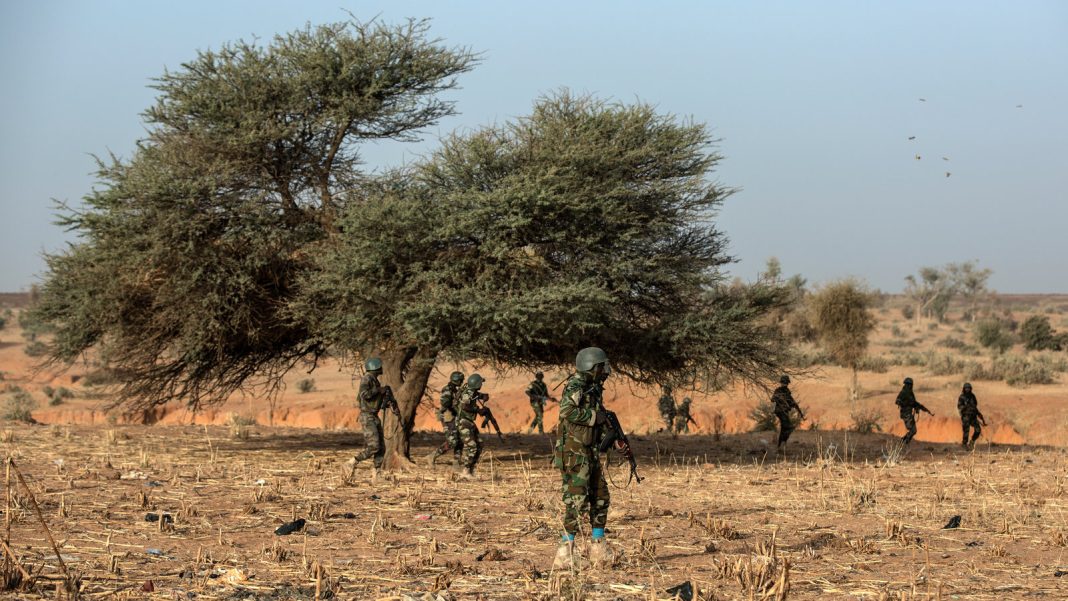

The latest attacks on a military base and a troop patrol in Borno State may appear, at first glance, to be another episode in Nigeria’s long-running fight against insurgency.
But there is a bigger story beneath the gunfire.
When a military base in Pulka comes under attack and troops are subsequently ambushed along the Buni Gari–Buratai road, the concern is not limited to military casualties or damaged vehicles. Such incidents raise broader questions about the security of the roads, communities and economic corridors that connect Nigeria to the rest of Africa.
And for a continent increasingly deepening its economic relationship with China, security is becoming just as important to trade as infrastructure, investment and financing.
The September 7 clashes, in which Nigerian troops under Operation HADIN KAI reportedly repelled an attack by suspected ISWAP fighters on the Pulka military base, came alongside an ambush on a separate military patrol by suspected Boko Haram fighters.
One soldier was wounded in the first confrontation, while military vehicles were reportedly damaged in the second. Nigerian forces subsequently deployed air assets, destroyed suspected insurgent camps and recovered weapons and ammunition, including RPG rounds.
These developments demonstrate that, despite years of counter-terrorism operations, insecurity remains a significant challenge in parts of Nigeria’s North-East.
Security and the cost of doing business
For businesses, however, the consequences of insecurity extend far beyond the battlefield.
Roads are the arteries of trade. They move agricultural products, manufactured goods, construction materials, machinery and consumer products between cities, regions and national borders.
When insecurity makes these routes unpredictable, transportation becomes more expensive and slower. Companies may have to increase spending on security, alter delivery routes or avoid certain areas altogether.
This matters for Africa-China trade because the relationship is no longer simply about Chinese goods arriving at African ports.
Chinese companies are increasingly involved in construction, manufacturing, energy, mining, telecommunications, logistics, transportation and infrastructure development across the continent.
Nigeria is an important market within this relationship.
Chinese businesses operating in Nigeria depend on functioning transport networks, reliable infrastructure and a predictable security environment to move equipment, personnel and goods.
The same applies to African businesses seeking to participate in supply chains connected to Chinese investment.
Infrastructure cannot work without security
China’s growing engagement with Africa has placed infrastructure at the centre of economic cooperation.
Railways, roads, ports, industrial parks, power projects and telecommunications networks can transform economies by reducing the cost of moving people and goods.
But infrastructure alone cannot guarantee economic growth.
A newly constructed road has limited economic value if businesses are afraid to use it.
A logistics corridor cannot reach its full potential if transporters face persistent security risks.
And an industrial investment cannot generate its expected returns if insecurity disrupts the movement of raw materials, workers or finished products.
This is where Nigeria’s security situation becomes relevant to the broader Africa-China economic conversation.
The North-East’s economic potential
Borno State is not simply a security theatre.
The North-East has significant agricultural, commercial and human-capital potential. Its location also gives it strategic relevance for trade with neighbouring countries in the Lake Chad region.
Improved security could therefore have implications beyond Nigeria’s borders.
If roads and commercial corridors become safer, local producers can access wider markets, traders can move more freely and businesses can operate with greater confidence.
For China and other international investors, stability could also make previously underutilised economic opportunities more attractive.
The reverse is equally true.
Persistent insecurity can discourage investment, increase operating costs and weaken the connectivity needed to integrate regional markets.
A challenge for Nigeria-China economic relations
Nigeria and China have built a substantial economic relationship over the years, with cooperation spanning infrastructure, trade, technology, manufacturing and other sectors.
But the next phase of that relationship should arguably place greater emphasis on security as an economic issue.
It is easy to discuss trade figures, railway projects, investment agreements and construction contracts without asking a fundamental question:
Can the infrastructure being built actually operate efficiently in an environment where insecurity continues to threaten key routes and communities?
That question deserves greater attention.
The solution is not for military operations to become a substitute for economic development. Rather, security and development must reinforce each other.
A secure environment allows infrastructure to generate economic value. Economic opportunities, in turn, can help create jobs and strengthen communities that might otherwise remain vulnerable to criminal and extremist networks.
From military security to economic security
The recent Borno attacks therefore offer an important lesson.
Nigeria’s fight against insurgency should not be viewed only through the lens of national defence. It should also be understood as part of the country’s broader economic strategy.
For Africa-China trade to expand sustainably, the continent needs secure roads, ports, borders, cities and industrial zones.
China can build infrastructure. African governments can establish policies and investment incentives. Businesses can provide capital, technology and jobs.
But none of these can fully succeed without security.
The gunfire in Borno may have been directed at military targets, but its implications reach much further.
Every insecure road represents a potential disruption to commerce. Every abandoned investment opportunity represents lost economic potential. And every community trapped by insecurity represents a missed opportunity for Africa to deepen its participation in global trade.
As Nigeria continues to strengthen its security operations in the North-East, the country also faces a larger economic imperative: turning security gains into conditions that allow trade, investment and regional connectivity to flourish.
For Africa-China relations, that may ultimately be one of the most important conversations to have.