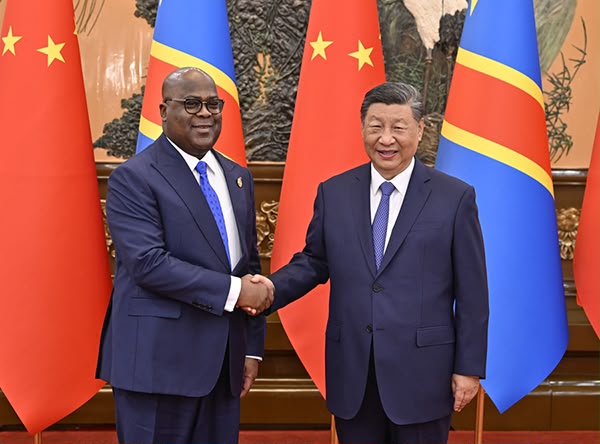

The Democratic Republic of Congo is taking a fresh step to strengthen its position in the global critical-minerals race as competition between China and the United States intensifies over the resources needed to power the modern economy.
Kinshasa has created a new task force to accelerate the implementation of its strategic minerals agreement with Washington, placing the DRC’s vast copper and cobalt reserves at the centre of growing international competition.
The move could mark an important shift in how DR Congo manages its mineral wealth and international partnerships.
For years, China has maintained a powerful position in the DRC’s mining sector, with Chinese companies playing a major role in the production and supply chains for cobalt and copper.
Those minerals have become increasingly valuable as countries race to expand electric vehicles, renewable energy, battery storage and other advanced technologies.
Cobalt is particularly important for battery production, while copper is essential for power grids, electric vehicles, renewable-energy systems and modern electronics.
With the global demand for these resources rising, control over their supply chains has become an increasingly important economic and geopolitical issue.
That has placed DR Congo in a unique position.
The Central African country possesses some of the world’s most important deposits of cobalt and copper, giving it enormous potential to attract investment and generate revenue. At the same time, Kinshasa faces pressure to ensure that its mineral resources produce greater benefits for the Congolese population.
The new task force is expected to help move the US-DRC minerals partnership from agreements into practical projects while encouraging more American investment in the country’s mining industry.
For Washington, strengthening ties with DR Congo could provide an alternative source of critical minerals as the United States seeks to build supply chains that are less dependent on China.
For Kinshasa, however, the strategy is about more than choosing between China and the United States.
The DRC has an opportunity to use growing international competition to negotiate better deals, attract investment from multiple partners and increase the value it captures from its own natural resources.
That could mean greater investment in local processing, infrastructure, technology and skills rather than continuing to rely heavily on the export of raw minerals.
The development does not necessarily signal a break between DR Congo and China. Beijing remains an important economic partner for Kinshasa, particularly in mining and infrastructure.
Instead, the latest move could reflect a broader attempt by the DRC to diversify its partnerships and gain greater influence over the future of its mining industry.
The stakes are high.
As the world accelerates its transition to electric vehicles and clean energy, demand for copper and cobalt is expected to remain strategically important. This means the DRC’s mineral wealth will continue to attract interest from major global powers.
For President Félix Tshisekedi’s government, the challenge will be turning that international interest into tangible benefits for ordinary Congolese citizens.
If Kinshasa succeeds, the DRC could move beyond being simply a major supplier of critical minerals and begin positioning itself as a more influential player in the global energy-transition economy.
The unfolding China-US competition may therefore present the DRC with a difficult balancing act—but also a rare opportunity to make its mineral wealth work harder for Africa’s development.