
By Prof Sheriff Ghali Ibrahim
It is universally acclaimed that economic power builds a nation and brings prosperity to the world. The economy builds a strong Army, institutions, knowledge, infrastructure, buys more allies and places a state within the corridors of power.
The U.S. is what it is today due to economic strength as the first-largest economy, which by extension gives it more leverage over states and nations, especially looking at military power. The United States has abused its economic strength by indulging in the so-called interventionist foreign policy, which led to the Iraqi invasion, Afghanistan, Syria, Iran, Venezuela, and its ambitious moves to invade Cuba, Colombia, Greenland and re-wage war against Iran. These have weakened the popularity of the United States, decimated its global influence and distanced its friends from its sphere of control and influence.
The U.S. has threatened its best friends in history: it threatened Canada of annexation, threatened Mexico, the European Union, China, Africa and many more significant entities within the framework of international economy and politics.
Some of the American allies, like Canada, had initially antagonised China to appease the U.S., but emerged as victims of absolute loyalty and obedience to the United States. The rift was initiated when Canada arrested Huawei’s Chief Executive, Meng Wanzhou, on a US warrant related to the company’s business dealings in Iran. When Canada imposed tariffs on China, China announced retaliatory tariffs on Canadian agricultural and food products last March, hurting Canadian farmers and effectively shutting Canada’s second-largest market for the crop.
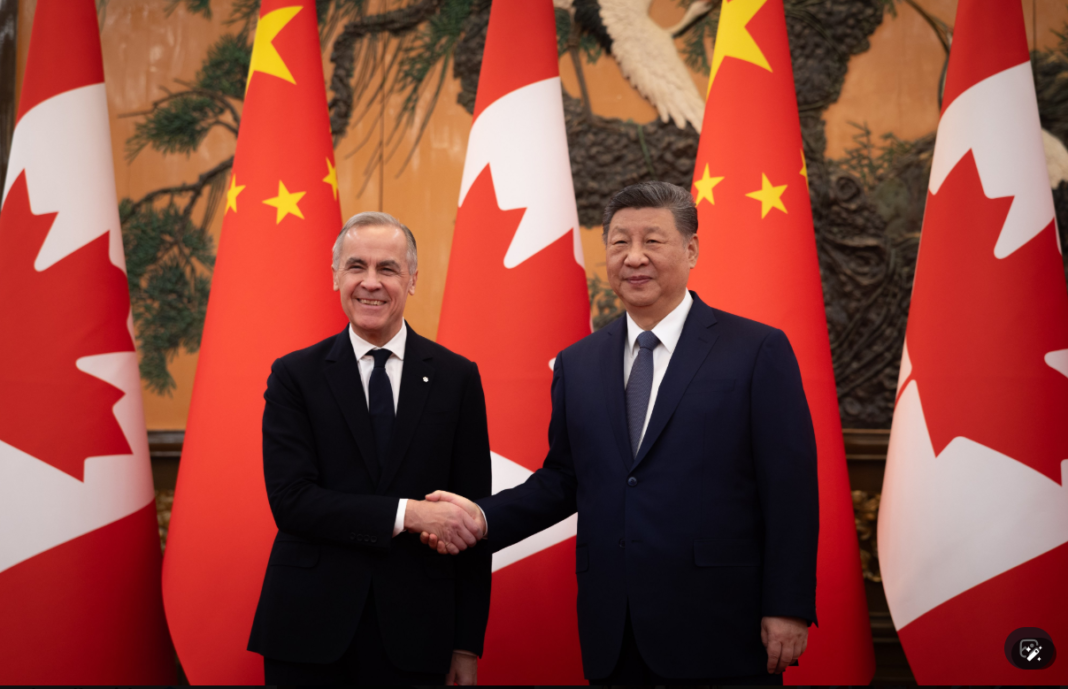
The most annoying part of Trump’s tyrannical tendencies was the campaign to annex Canada and make it an integral part of the American States, which angered Canada and pushed it to look for alternative means of survival. That alternative means, if you may, is the People’s Republic of China. This has led to a political and economic rapprochement between Canada and China. Carney is the first Canadian Prime Minister to visit China in nearly eight years.
Prime Minister Mark Carney hailed a new “strategic partnership” with China during a meeting with President Xi Jinping on Friday, 16th January, 2026, as the US ally took steps to reset ties with Beijing in the face of historic friction with Donald Trump. Canada would ease tariffs on Chinese electric vehicles and expects China to significantly reduce tariffs on Canadian canola seed later this year.
Trump loses an ally, an immediate neighbour and an integrating partner under the North American Free Trade Agreement (NAFTA), for being one who creates a strained international system.
This was openly posited by Carney while speaking to Xi in Beijing’s Great Hall of the People on Friday morning. Carney described the countries’ “new strategic partnership” as one that could work to improve a strained international system, and a move to a “new international order.”
Canada also opposes the American global dictatorship and hegemonic disposition and supports China’s Global Governance Initiative when Prime Minister Carney emphasised that the deepening partnership would “help improve” the multilateral system, which “in recent years had come under great strain.”
The United States loses, and China wins, as Canada revealed that it will allow up to 49,000 Chinese electric vehicles (EV) into the Canadian market per year, with the most-favoured-nation tariff rate of 6.1%. The move rolls back what had previously been an irritant in their relations: a blanket 100% tariff on the goods imposed by Canada in tandem with the US in 2024.
Canada also expects China to reduce its tariffs on Canadian canola seed to about 15% by March 1, a significant drop from the roughly 85% levels that had been imposed on the entry of the good into China, where it makes up a $4 billion market. Other products like lobsters and peas would also see tariffs lifted on that timeline, according to Canada.
This portends that Trump’s Tariff war, Trade War and ineptitude break a longstanding relationship with American allies by bringing them closer to China. Carney and Xi discussed increasing two-way investment in clean energy and technology, agri-food, wood products and other sectors as part of a bid to elevate exports to China by 50% by 2030.
It also reveals that Western states have been misguided and misled by the U.S. in its bid to contain China, but now they are waking up from their slumber and rediscovering the lost path to national dignity and self-respect. They all know that China is not a threat, as once declared by Canada, but ignoring that to please the United States. It is clear what the U.S. is in its critical moment of Chinaphobia, which needs only the understanding that the U.S. must accept the realities of natural laws and evolutionary etiquette before it frees itself from the shackles of envy and strategic narcissism.
The repercussion of Canada’s move is that Trump may develop narcissistic outrage against Canada or China to convince himself that he is still in control. He may turn his anger on to Columbia, Cuba or Iran. Trump may decide to turn his anger on Nigeria or the entire continent of Africa due to the psychological trauma of losing Canada to China.
In conclusion, China does not fire any shots at Trump or the United States; China does not threaten the U.S. or campaign against it, but its kindness is being felt and acknowledged. This has continued to make China rise. The world should also not be oblivious of the fact that China is a global industrial hub, a great market and a tool for global integration, not a military machine that intends to destabilise the world for selfish economic or political interest.
Prof Ghali is the provost, ICPC’S Anti-Corruption Academy of Nigeria (ACAN), and Head of Contemporary China-Africa Research in Nigeria