
By Sheriff Ghali Ibrahim
The Group of Twenty, commonly known as the G20, is a forum of both developed and developing economies informally formed to deal with global economic challenges and strengthen global economic development. Unlike the G6, G7 and the hitherto G8, which are comprised of the highly most industrlialized countries of the world, such as the United States, the United Kingdom, France, Canada, Japan, Italy and Germany, the G20 represents the entire regions of the world and economies of the world in terms of strength. Russia was sacked from the G8 after the invasion of Crimea which reduced the G8 to G7 as currently existing.
The G20 was founded in 1999 after the Asian financial crisis of 1997 – 1998 as an informal forum for the Finance Ministers and Central Bank Governors of the most important industrialised and developing economies to discuss international economic and financial stability. Not just economic issues, the G20 has emerged to represent the neofunctionalist theoretical analogy of Spill-Over effect, which suggests dealing with more issues of relevant concern from other issues of discussion. Today the G20 deals with issues of climate change, war and conflict, human rights, trade, regional challenges, international challenges and migration, among others.
The size of the G20 in terms of GDP, demography and trade is enormous, representing 85% of global GDP, 75% of international trade, and two-thirds of the world’s population. The G20 comprises 19 countries (Argentina, Australia, Brazil, Canada, China, France, Germany, India, Indonesia, Italy, Japan, Republic of Korea, Mexico, Russia, Saudi Arabia, South Africa, Türkiye, the United Kingdom, and the United States), the European Union, and since 2023, the African Union.
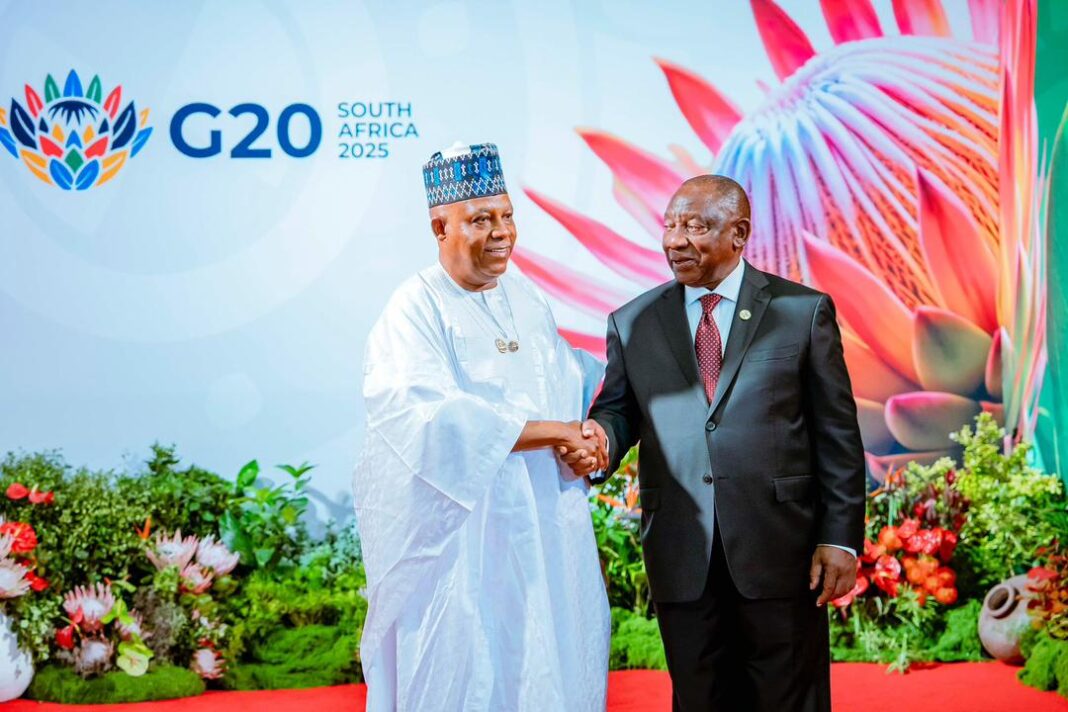
The 2025 G20 Johannesburg summit is the twentieth meeting of the Group of Twenty (G20), a Head of State and Government meeting held on 22–23 November, 2025. It is the first G20 summit to take place on the African continent. It was also notable for the non-attendance by the top leaders of several major economies, including Chinese leader Xi Jinping, the United States president Donald Trump and Russian President Putin. South Africa assumed the G20 presidency from December 1, 2024, to November 2025, becoming the first African country to chair the forum; the term coincided with ongoing efforts by the international community to advance the United Nations Agenda 2030.
The G20 Summit, 2025 signifies African turn and African time to showcase ability and capacity to be included into the bandwagon of Global Governance as posited by President Xi Jinping of China when he promoted the idea of the initiative and uphold the principle of multilateralism and commitment to international rule of law among other things. It is in line with this that President Cyril Ramaphosa reiterated this priority, saying that South Africa would “put Africa’s development at the top of the agenda when we host the G20 in 2025”.
The G20 Summit clearly showed the nonchallant attitude of the United States towards African progress, inclusivety and development. It shows hateredness and rivalry towards the African cause and agenda, but understanding this fully, South Africa succeeded and resolved that, with or without the United States, it means the world can make a significant progress in global governance. Several preparatory meetings experienced disagreements among member states, and the United States declined to participate in some early sessions, citing concerns with aspects of the agenda. South African Foreign Minister Ronald Lamola stated in response that the G20 “should send a clear message that the world can move on with or without the US”. The United States claimed there is anagenda against the white farmers of South Africa, just Trump wrongly claimed of Christian Jenocide in Nigeria.
It is therefore, pertinent to mention that, Africa is gradually emerging and there is no contribution Africa cannot offer in the development of peace and progress of the international system. President Xi of China clearly understands that and promote that idea globally, but President Trump does not hold similar belief. Africa is ready and the time is now to seek equal treatment, respect and fairness in all ramifications and as it relates to international engagement against all odds.
Prof Sheriff is the Head Of The International Centre, University Of Abuja, And Director Centre For Contemporary China-Africa Research In Nigeria