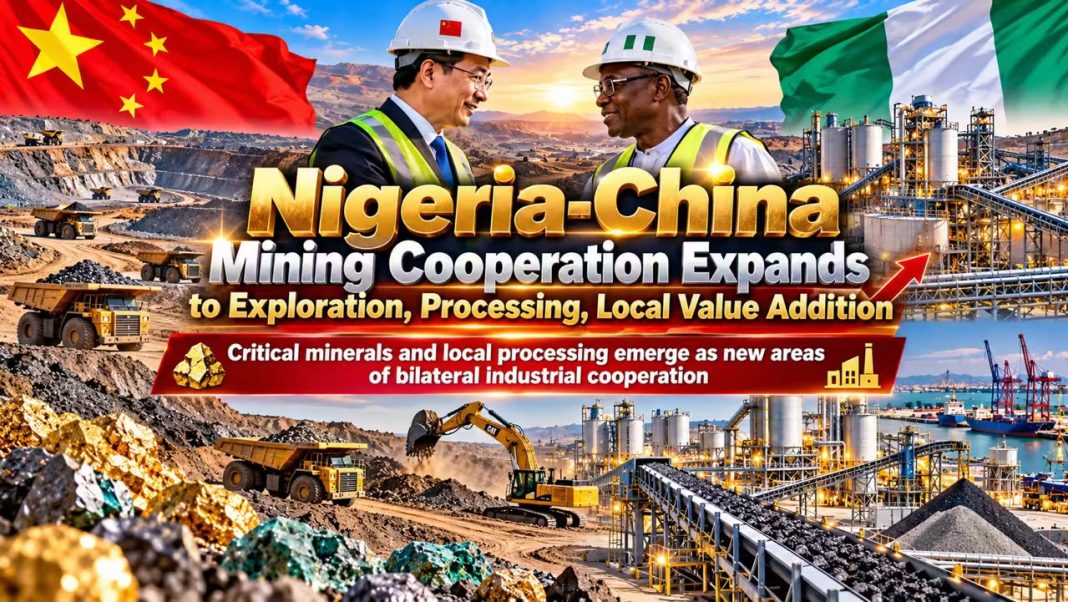

Critical minerals and local processing emerge as new areas of bilateral industrial cooperation
Nigeria and China are expanding cooperation in the solid minerals sector. The partnership is gaining attention in geological exploration, mineral processing, technology transfer and local value addition.
The development comes as Nigeria seeks to diversify its economy and attract more mining investment. The government also wants to reduce dependence on exports of unprocessed minerals.
Mining gains importance in Nigeria-China ties
Mining has become an important area of the Nigeria-China Comprehensive Strategic Partnership.
In 2024, both countries elevated their bilateral relations. Their joint statement called for stronger cooperation in energy and mineral resources development.
The two sides also encouraged cooperation to establish factories in Nigeria. Such facilities could serve both domestic and export markets.
Nigeria has deposits of lithium, gold, tin, lead, zinc, iron ore and limestone. The Federal Government is seeking more investment in geological data, exploration, mining technology and processing.
China sees opportunities in Nigeria’s minerals
Chinese Ambassador to Nigeria Yu Dunhai and Minister of Solid Minerals Development Dele Alake have discussed stronger cooperation in mineral exploration and development.
Nigeria has also encouraged qualified Chinese mining companies to invest in the sector.
The country is seeking Chinese technology, technical expertise and management experience to support mining development.
Recent bilateral engagements have also focused on critical minerals, exploration, processing, technology transfer and capacity building.
Local processing becomes a priority
A major focus of Nigeria’s mining policy is local value addition.
The government wants to process more minerals locally instead of exporting them mainly in raw form.
Local processing could help Nigeria retain more economic value. It could also create jobs and strengthen domestic industrial capacity.
The approach could attract investment in mineral processing plants and refining facilities. It could also create demand for mining equipment and supporting infrastructure.
Opportunities extend beyond mining
For Chinese companies, opportunities could go beyond mining licences and mineral extraction.
Potential areas include geological surveys, drilling and mining machinery. They could also include crushing and screening equipment, beneficiation plants and industrial facilities.
Mining development also depends on supporting infrastructure.
Large-scale extraction and processing require reliable electricity, roads, railways, water supply and logistics.
This creates links with other areas of Nigeria-China cooperation. These include power infrastructure, transportation and industrial development.
Critical minerals attract global attention
Critical minerals are gaining international attention as demand rises.
These resources support batteries, renewable energy systems, electronics and advanced manufacturing.
Nigeria wants to position itself within these emerging supply chains. At the same time, the country wants to increase the amount of mineral processing carried out locally.
However, several factors will shape the sector’s growth.
These include geological information, infrastructure, reliable electricity and regulatory conditions. Environmental standards, financing and the implementation of individual projects will also remain important.
A wider industrial partnership
For Nigeria, greater local processing could increase the value generated from its mineral resources. It could also support broader industrial development.
For Chinese investors, Nigeria offers opportunities across the mining value chain.
These opportunities range from exploration and mining to equipment supply, mineral processing and local manufacturing.
As Nigeria and China deepen their Comprehensive Strategic Partnership, solid minerals are emerging as another potential area of long-term industrial cooperation.