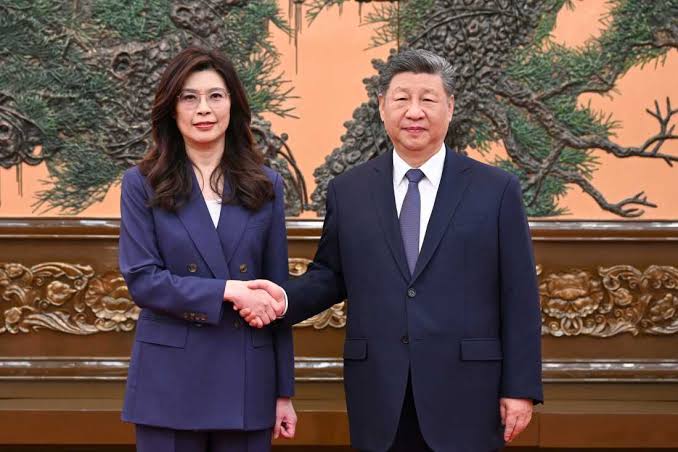
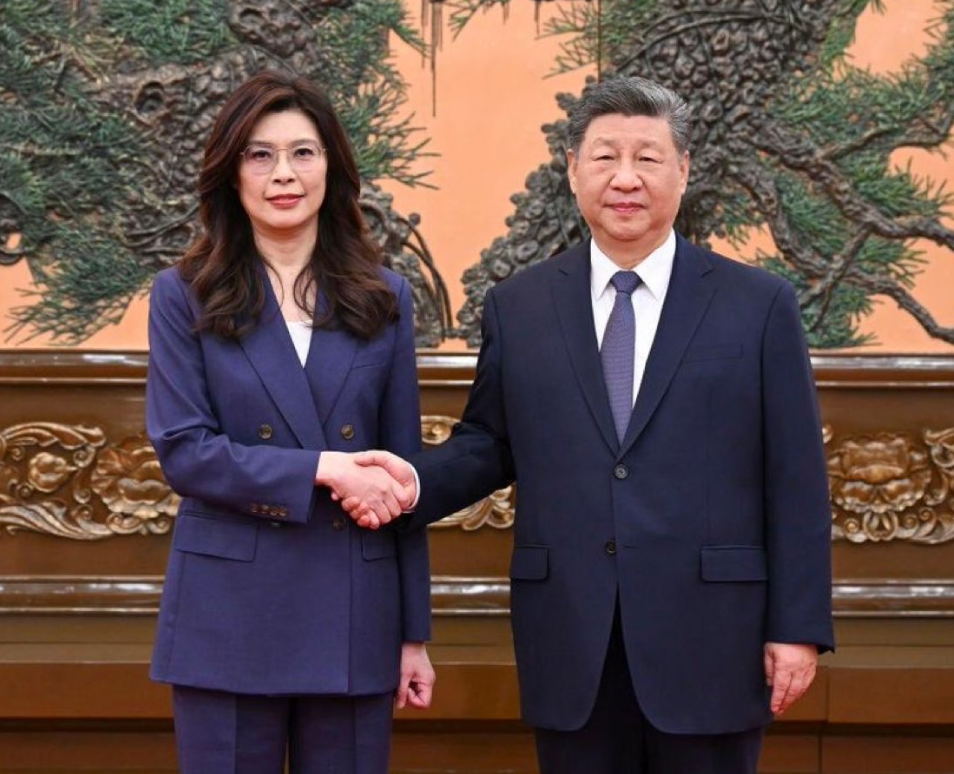

Chinese President Xi Jinping on Friday expressed confidence that Taiwan will eventually reunite with mainland China, as he hosted Taiwanese Kuomintang (KMT)opposition leader, Cheng Li-wun in Beijing.
Speaking during the meeting, Xi emphasized the importance of peace and cooperation across the Taiwan Strait, stating that people on both sides share a common identity and aspirations.
“Compatriots on both sides are both Chinese, and we need peace, we need development, we need communication and we need cooperation. This is a common wish,” Xi said, according to reports.
He added that the historical trend toward closer ties between the mainland and Taiwan is inevitable. “The compatriots on both sides of the strait will get closer and get together. This is a certainty of history, and we are fully confident,” he said.
Cheng, who leads the Kuomintang (KMT), is on an official visit to China that included stops in Jiangsu Province and Shanghai before arriving in Beijing. The KMT traditionally supports closer relations with China, in contrast to Taiwan’s ruling Democratic Progressive Party (DPP), which rejects Beijing’s territorial claims over the self-governed island.
During her visit to the Sun Yat-sen Mausoleum in Nanjing, Cheng called for “reconciliation” and “unity” across the Taiwan Strait, invoking the legacy of Sun Yat-sen, founder of the KMT.
Relations between Beijing and Taipei have remained strained since 2016, when then-President Tsai Ing-wen of the DPP took office and refused to recognize China’s claim over Taiwan. In response, Beijing cut off high-level official communications with the island.
Cheng’s meeting with Xi marks the first such engagement between a KMT leader and the Chinese president in over a decade. The last meeting took place in 2015, when then-KMT chairman Eric Chu held talks with Xi.
Analysts view the visit as a significant step toward reviving dialogue between the KMT and China’s ruling Communist Party of China, amid ongoing tensions across the Taiwan Strait.
The visit also comes at a sensitive time in global geopolitics, with Xi expected to host U.S. President Donald Trump next month. The United States remains Taiwan’s primary arms supplier, with Washington approving a record $11 billion in arms sales to Taipei last year—a move that drew strong criticism from Beijing.
China has consistently opposed U.S. military support for Taiwan, responding with sanctions against several American defense firms and their personnel.
Cheng, who was elected KMT chair in October last year, is expected to continue engagements aimed at promoting cross-strait dialogue, even as broader political tensions remain unresolved.