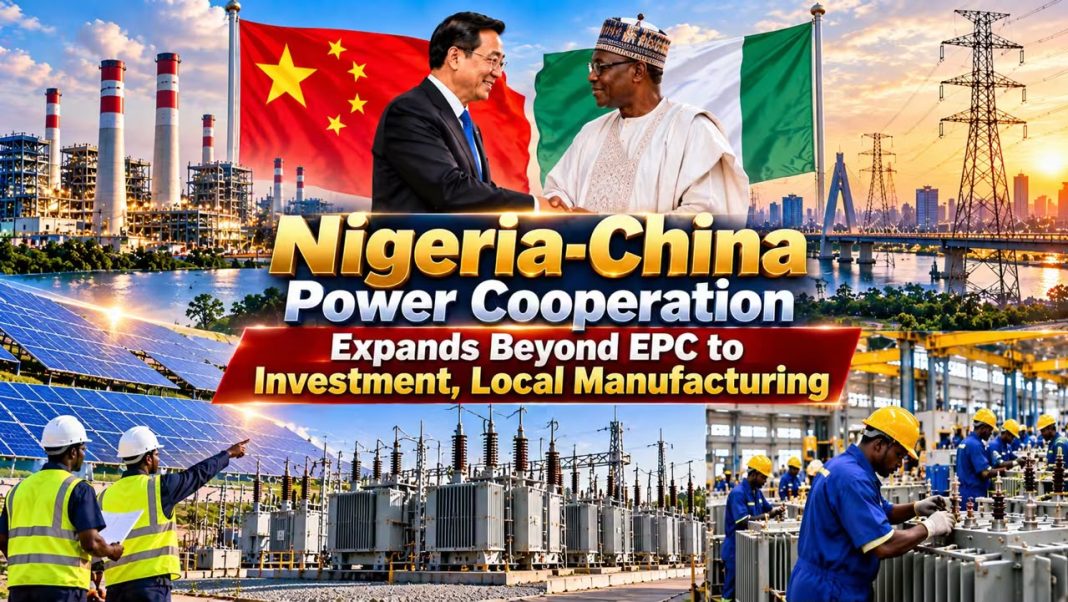

New focus covers generation, transmission, transformers, renewable energy, storage and mini-grids
The new focus includes investment, renewable energy, technology transfer and local manufacturing.
Chinese companies have participated in major Nigerian power projects for years. Their involvement has covered power generation, transmission and engineering construction.
Recent engagements between officials from both countries point to a broader partnership. Areas under discussion include generation, transmission and distribution, transformers, solar energy, battery storage, mini-grids and electrical equipment manufacturing.
Power remains a major challenge
Power remains a major constraint on Nigeria’s industrial development.
World Bank data puts electricity access in Nigeria at about 62.5 per cent in 2024. Many businesses still rely on alternative power sources, which increases production and operating costs.
Nigeria is also participating in Mission 300. The initiative aims to connect 300 million Africans to electricity by 2030.
In 2026, Chinese Ambassador to Nigeria Yu Dunhai and Nigerian officials held discussions on electricity infrastructure and renewable energy.
China has identified power as an important area of bilateral economic cooperation. Nigeria, meanwhile, wants more foreign investment to improve electricity supply and support industrialisation.
Cooperation moves beyond construction
The discussions point to a gradual shift in Nigeria-China power cooperation.
Both sides are looking beyond individual construction contracts. The broader model could combine investment, technology transfer and industrial capacity development.
However, increasing generation alone will not solve Nigeria’s electricity challenges. The country also needs stronger transmission and distribution networks.
Grid expansion will require substations, transmission lines, transformers and switchgear. It will also create demand for cables, smart meters and other distribution equipment.
These needs could open new opportunities across the electricity equipment supply chain.
Renewable energy gains ground
Renewable energy is becoming an increasingly important part of Nigeria’s power market.
Solar systems, battery storage and mini-grids are expanding in communities and commercial areas with limited grid access.
Under the World Bank-supported Nigeria Electrification Project, Nigeria had deployed 180 mini-grids and more than one million solar home systems by the end of 2024.
Further expansion of distributed renewable energy could increase demand for solar equipment, inverters, batteries, transformers and energy-management systems.
Local manufacturing creates new opportunities
Local manufacturing is another area attracting attention.
Nigeria has repeatedly called for foreign investment that supports domestic production, technology transfer, employment and local value addition.
Greater local assembly and manufacturing could reduce Nigeria’s dependence on imported electrical equipment.
Potential areas include transformers, cables, switchgear, solar equipment and other electrical components.
Local production could also strengthen domestic supply chains and improve maintenance capacity.
For Chinese companies, this could create opportunities beyond equipment supply and project construction. They could also establish manufacturing and technical service operations in Nigeria.
Regional market offers further potential
The pace of this transition will depend on financing, commercial viability and government policies.
Agreements reached on individual projects will also determine how quickly the sector develops.
Nigeria’s position as West Africa’s largest economy offers another opportunity. The country could serve as a base for companies targeting the wider regional market.
Electricity integration across West Africa is also advancing through the West African Power Pool.
A broader Nigeria-China power partnership
The development points to a broader model of Nigeria-China power cooperation.
The partnership could combine engineering, investment, equipment supply, technology transfer and local production.
For Nigeria, the focus is shifting beyond power infrastructure. The country also needs the industrial capacity to support and maintain that infrastructure.
For Chinese companies, opportunities now extend across the electricity value chain. These include generation, transmission, transformers, solar energy, battery storage, mini-grids and local manufacturing.