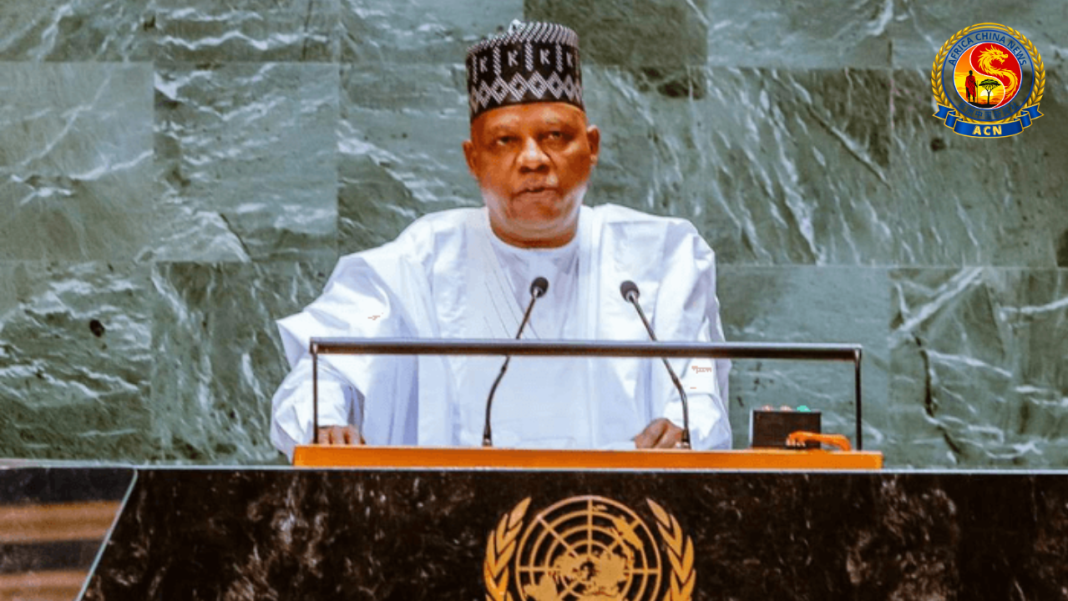

Nigeria has renewed its call for a stronger African voice in global decision-making, with Vice President Kashim Shettima urging reforms to the United Nations Security Council and the international financial system.
Shettima delivered President Bola Ahmed Tinubu’s statement at the General Debate of the 81st United Nations General Assembly in New York on Thursday.
Representing the President, Shettima said the global system must reflect the realities of 2026 rather than preserve the power structure established in 1945.
He called for Africa to receive at least two permanent seats on the UN Security Council, with the full rights of permanent membership, including veto power for as long as the veto remains, alongside five non-permanent seats.
Nigeria’s position, he said, is consistent with the African Union’s Ezulwini Consensus and Sirte Declaration.
Nigeria Pushes for Development Financing
The Vice President also called for reforms to the international financial architecture, saying developing countries need wider access to concessional financing and debt frameworks that take their development needs into account.
He said Nigeria supports innovative financing through private capital, blended finance, South-South cooperation and strategic partnerships to fund infrastructure, climate adaptation and sustainable development.
AfCFTA Key to Africa’s Economic Transformation
Shettima described the African Continental Free Trade Area as one of Africa’s major opportunities to expand intra-African trade, strengthen regional value chains and accelerate industrialisation.
He said Africa must move beyond its traditional role as an exporter of raw materials by increasing value addition, manufacturing, technological innovation and knowledge-driven growth.
Nigeria Links Energy Transition to Development
On climate change, Shettima said Nigeria rejects a choice between development and climate action.
He said Nigeria remains committed to achieving net-zero emissions by 2060 while expanding access to affordable and reliable energy.
The country’s energy transition strategy, he said, includes renewable energy, clean cooking, gas as a transitional fuel, climate-smart agriculture and nature-based solutions.
Shettima also called for climate finance that is accessible, predictable and adequately funded, arguing that developing countries should be able to pursue climate action without compromising development.
Nigeria Seeks Responsible Use of AI
Artificial intelligence also featured prominently in Nigeria’s address.
Shettima said AI should be directed towards healthcare, education, agriculture, governance and economic productivity rather than conflict and destruction.
He said Nigeria is investing in digital public infrastructure, broadband connectivity, innovation ecosystems, research institutions and technology entrepreneurship, while inviting international partnerships to support the country’s young technology community.
On security, Shettima called for stronger international cooperation against terrorism, organised crime, cyberattacks and illicit finance.
He said Nigeria’s experience in confronting terrorism demonstrates that military action must be supported by education, economic opportunity, accountable governance and protection of communities.
The Vice President further called for urgent diplomacy to address conflicts, including the war in Sudan, and urged parties to protect civilians and uphold international humanitarian and human rights law.
Closing the address, Shettima said Nigeria remains committed to cooperation, dialogue and partnership, urging the United Nations to become more inclusive and responsive to the challenges facing the world.
He said a reformed and effective United Nations remains essential to building a peaceful, just and sustainable future.