
Africa’s imports of Chinese electric motorcycles and three-wheelers rise 60% to $114.6 million
Wheelers are rising as African markets expand battery-swapping networks, local assembly and electric mobility services.
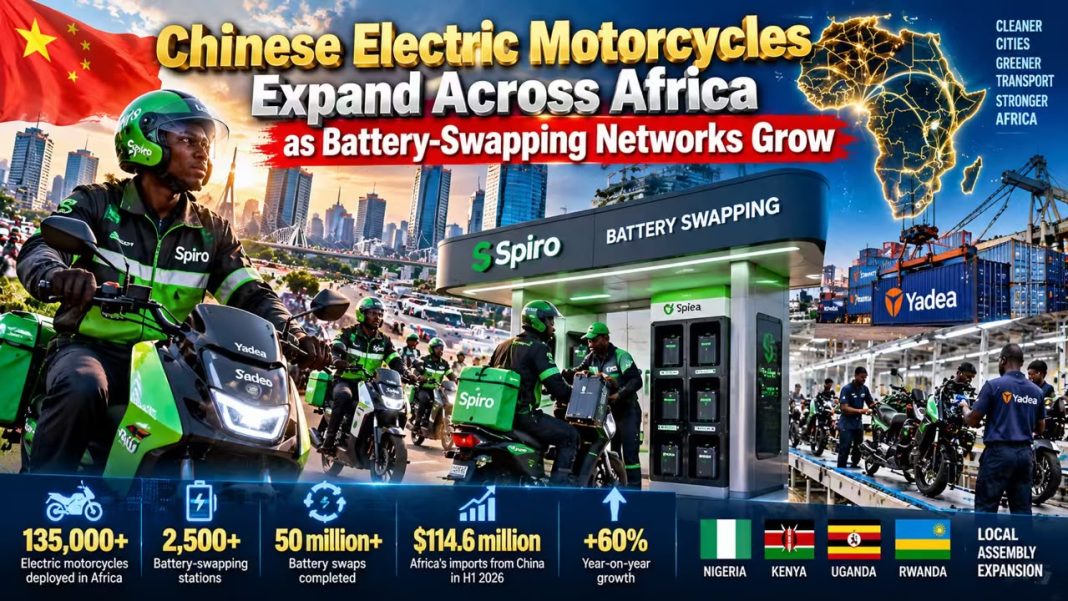
Africa imported about $114.6 million worth of electric motorcycles and three-wheelers from China in the first half of 2026. That was about 60% higher than the same period in 2025, based on an analysis of Chinese customs data.
Electric motorcycles gain ground
The growth reflects rising demand for electric motorcycles in commercial transport, delivery and urban logistics.
Motorcycles are widely used for daily transport and income-generating activities across many African cities.
Chinese electric two-wheeler maker Yadea has also partnered with African electric mobility company Spiro.
The partnership will connect Yadea’s manufacturing and supply-chain capacity with Spiro’s African operations and battery-swapping network.
The companies plan to develop electric motorcycles suited to African roads and commercial use. These include motorcycle taxis, delivery services and logistics.
Battery swapping drives expansion
Spiro has deployed more than 135,000 electric motorcycles across Africa. It also operates more than 2,500 battery-swapping stations.
The company says its network has completed more than 50 million battery swaps.
Spiro is also developing assembly or production operations in countries including Nigeria, Kenya, Uganda and Rwanda.
Battery swapping is becoming a key part of Africa’s electric motorcycle market.
Commercial riders depend on their motorcycles for income. Long charging times can therefore reduce the hours they spend on the road.
Battery swapping allows riders to replace depleted batteries quickly and return to work.
Investment moves beyond motorcycles
Africa’s electric mobility market is attracting investment in more than vehicles.
Spiro announced a $270 million funding round this year to support its expansion.
The growth could create opportunities for Chinese companies involved in batteries, electric motors, control systems, swapping equipment and spare parts.
Local assembly could also support job creation, technology transfer and greater domestic value addition.
Challenges remain
The sector still faces several challenges.
These include limited access to affordable financing, unreliable electricity supply and gaps in charging infrastructure.
Battery standards and swapping systems also differ among operators. This could make it harder to achieve interoperability as the market expands.
Despite these challenges, electric motorcycles are creating a new path for Africa’s shift towards clean transport.
Unlike markets focused mainly on electric cars, Africa’s transition is likely to involve motorcycles used for transport, deliveries and small businesses.
For China-Africa economic cooperation, the trend points to a broader opportunity.
The relationship is moving beyond the export of finished motorcycles towards an ecosystem involving vehicles, local assembly, batteries, swapping stations, financing and mobility services.
As demand grows in markets such as Nigeria, Kenya, Uganda and Rwanda, electric motorcycles could become an important part of China-Africa cooperation in green transport and new-energy industries.